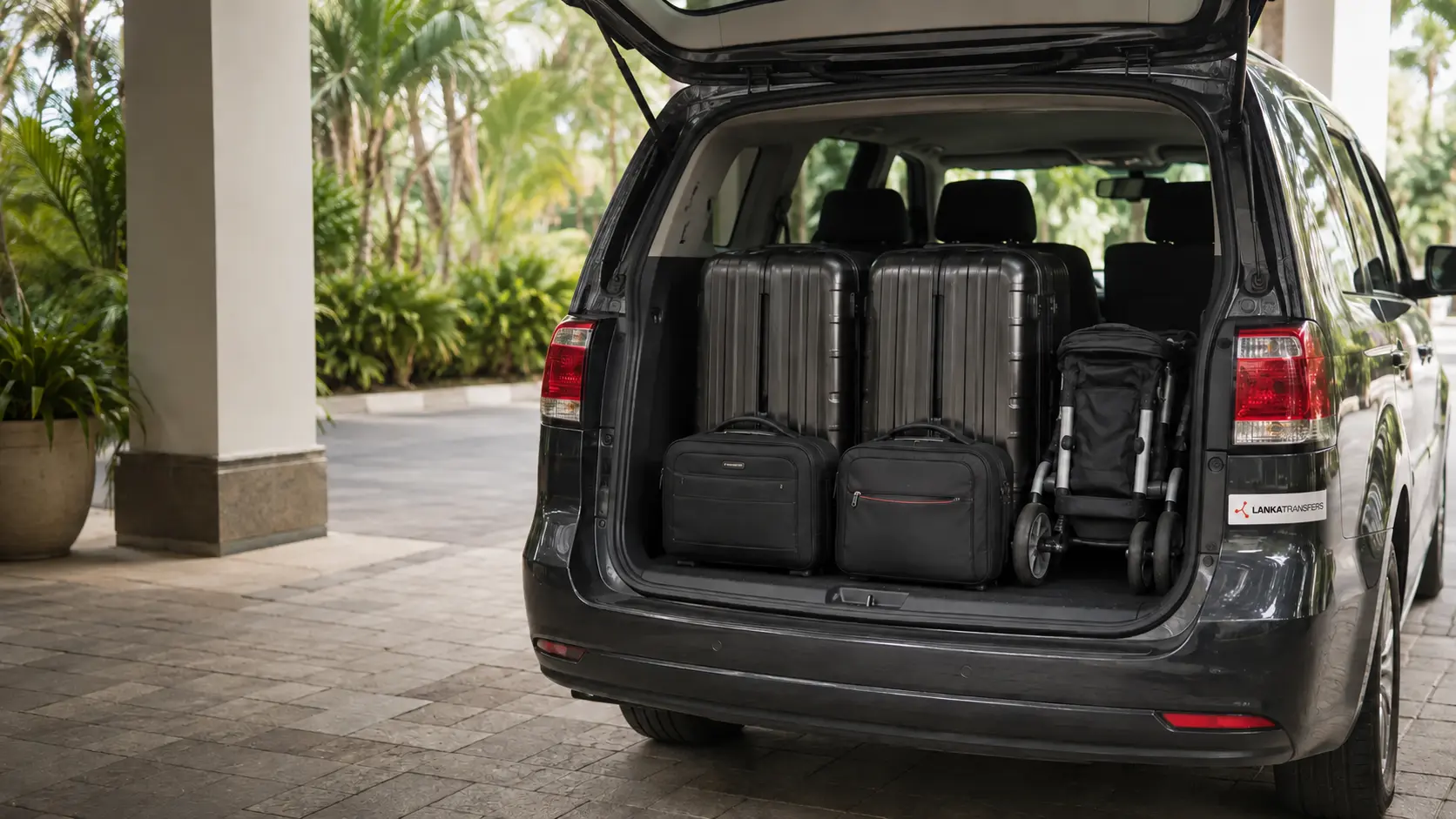
A booking that says ‘two passengers’ tells the driver almost nothing about luggage. Two travellers may carry two cabin bags, or two large cases, backpacks, a folded stroller and camera equipment. Record large and small bags separately.
Count bags the way the boot sees them
Use the outside dimensions, not the airline label alone. Hard-shell cases do not compress; hiking packs and soft duffels sometimes do. An expanded case should be counted at its travel size, not the size it had when it left home.
Do a final count before each journey segment. Shopping, laundry bags and equipment collected during the trip can make the return load different from the airport arrival.
If an item cannot safely remain on your lap for the whole journey, include it in the luggage count.
Seats and luggage are different capacities
A vehicle may legally carry several passengers while offering limited enclosed luggage space. Filling spare seats with cases can affect comfort, seat-belt use and visibility, and it should not be the default plan.
LankaTransfers scheduled rides show both passenger seats and luggage capacity from the approved vehicle profile. Compare both figures. A ride with enough seats may still be the wrong match for the bags entered in your segment.
When the profile does not answer an unusual packing question, request confirmation before selecting it. A short message and a photograph of specialist equipment can prevent a poor match.
Families need space around the luggage
Pushchairs, child seats, travel cots and feeding bags are easy to overlook because they are not conventional suitcases. Add them to the request and explain whether any item folds.
A child seat also uses seating space and may affect the practical arrangement of adults beside it. Confirm the requirement rather than assuming a vehicle carries the correct seat automatically.
For airport pickups, keep one small bag with food, medicine, a change of clothes and documents within reach. The rest can stay properly packed instead of being opened at the roadside.
Use the private-transfer guide to match vehicle, route and driver before comparing a scheduled ride.
Choose the right structure →Describe equipment that is not a suitcase
Surfboards, bicycles, wheelchairs, diving gear and musical instruments need dimensions and handling details. Vehicle luggage numbers are designed for ordinary bags and do not prove that a long or fragile item fits.
State whether equipment can be dismantled, whether a wheelchair user transfers to a vehicle seat and whether a roof rack or other fitting is acceptable. Do not assume such fittings are available on every vehicle.
Valuable or fragile items should have an agreed placement. A private transfer reduces handovers, but it does not remove the traveller’s responsibility to pack and insure possessions appropriately.
Plan stops with luggage security in mind
On a point-to-point transfer, all of your travel belongings may be in the vehicle. Ask the driver about a secure stopping arrangement before leaving the vehicle for a longer visit.
Keep passports, money, medicine and essential electronics with you. Do not leave them visible in the cabin, even when the stop seems brief.
If a sightseeing visit is central to the day, make it part of the route request so waiting, parking and luggage can be considered together rather than improvised after pickup.
Use one luggage count for each segment
The same group can need different capacity on different legs. An airport transfer may carry every bag; a return touring day from a hotel may carry only daypacks.
The journey builder carries passenger and bag counts into the next segment for convenience, but they remain editable. Treat the carried value as a reminder to check, not proof that nothing changed.
Accurate luggage information gives drivers a fair chance to offer the right vehicle and gives travellers a more comfortable trip. It is one of the simplest ways to improve the service before anyone starts the engine.